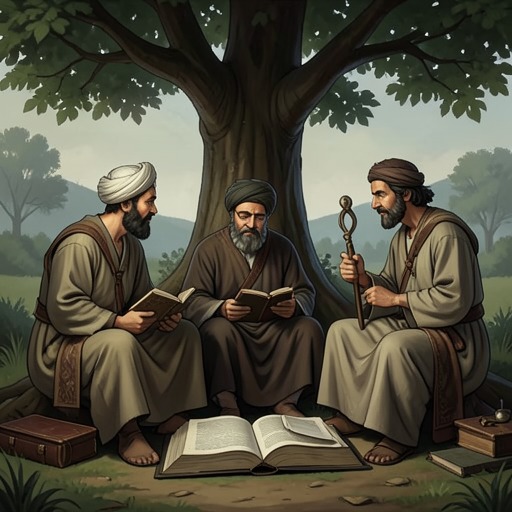
Jamia Masjid
Life of PiJamia Masjid is a mosque in Pondicherry that Pi Patel first approaches cautiously and later visits as a place of worship. Its open, spare setting becomes more than a landmark in his hometown: through its prayer, the mosque gives him a bodily and communal experience of Islam that unsettles his assumptions about the faith.
Setting and Architecture
The mosque stands in Pondicherry’s Muslim quarter, not far from the zoo. Pi describes the neighborhood as small and quiet, with Arabic writing and crescent moons on house fronts. On Mullah Street, he sees Jamia Masjid from outside before deciding to enter. The building is clean and white, with green-painted edges, and its construction opens around an empty central room. Long straw mats cover the floor; two slim, fluted minarets rise against the coconut trees behind them.
The architecture makes a strong first impression through its openness and simplicity rather than ornament. Pi finds the building pleasant and quiet, though at first he does not recognize anything evidently religious or interesting about it. That response belongs to his limited perspective: the space’s significance becomes clearer when he later experiences the worship conducted within it.
Pi’s First Approach
At fifteen, Pi explores his hometown and pauses at the mosque, careful to remain outside. Christianity has already challenged his expectations, but he has heard Islam described in terms that make him wary: fewer gods, greater violence, and unfavorable accounts of Muslim schools. His reluctance to step inside is therefore shaped by inherited impressions, not by any encounter with the worshippers or the practice of the faith.
His first visit is a brief act of looking from a distance. The open building is empty when he peers in, and he moves on without entering. The contrast between the welcoming physical space and his hesitation prepares the ground for a different kind of approach, one made through personal contact rather than speculation.
Prayer and Participation
Pi’s later visits bring him into closer contact with the mosque’s religious life. At a bakery just beyond it, he meets a Muslim baker who invites him inside and explains how bread is made on heated pebbles. When the call to prayer sounds from the mosque, the baker interrupts his explanation, lays out a rolled carpet in the flour-dusted bakery, and performs his prayer. Pi watches the repeated movements: standing, bowing, kneeling, touching his forehead to the floor, and beginning the sequence again. The encounter gives Pi an immediate image of Muslim devotion beyond what he had assumed from the mosque’s exterior.
Pi returns to Jamia Masjid and asks the baker about his religion. Later, he sits cross-legged in the mosque, listening to the imam until the time for prayer. The scattered worshippers then arrange themselves shoulder to shoulder in rows, each space filled until the lines are solid. Pi joins them and finds bringing his forehead to the ground a deeply religious contact. The prayer is not merely something he observes from the edge of the room: its shared order and physical gesture draw him into the worshipping congregation.
Narrative Significance
Jamia Masjid marks a change in how Pi encounters Islam. His first response is governed by hearsay and distance; repeated visits, conversation with the baker, and participation in prayer give that distance way to experience. The mosque’s open construction is echoed by the movement from cautious observation to shared worship, while the rows of worshippers make religious belonging visible as a communal practice.
The mosque also anchors Pi’s understanding of religion in ordinary material and bodily acts. Nearby bread-making, the call to prayer, a carpet unrolled in a workplace, and the coordinated movements of worship all contribute to his sense of Muslim devotion. In this episode, Jamia Masjid is not only a setting but the point of entry into a faith Pi had previously judged from outside.